

Gravy for High-Volume Catering: Portion Planning, Holding & Menu Uses
plan
Make the sauce the smoothest part of service.
When fifty plates become two hundred, gravy must stay smooth, hot and available. This guide shows caterers how to control portions, preparation and holding before the first plate reaches the pass.
Measure a serve, forecast demand and allow for spillage. Fun Foods Direct's Gravy collection contains traditional beef and chicken mixes; both use 100g powder per litre of cold water. Prepare as directed, check actual usable yield and keep potentially hazardous gravy at 60°C or hotter when hot holding.
How much gravy do you need for 50, 100 or 200 guests?
Start with the meal, not the packets. A roast-and-mash plate may need more sauce than a pie. Test with your real ladle and estimate how many guests will take gravy. For self-service buffets, provide a dedicated gravy ladle and observe how guests actually pour.
At an illustrative 80mL per guest, 50 portions need 4L, 100 need 8L and 200 need 16L of finished gravy. Add a hypothetical 10% planning reserve and the targets become 4.4L, 8.8L and 17.6L.
One 80mL serve per guest, plus 10% contingency.
Useful for a catered lunch with a consistent plated portion.
Confirm production and hot-holding capacity before committing.
The practical yield calculation
Both mixes use 100g powder per litre of cold water. Measure usable finished gravy from a test batch: added powder, evaporation and transfer losses affect actual volume.
This illustrative pack forecast assumes a trial yields 1L usable gravy per 100g powder. It is not a manufacturer guarantee; replace it with your measured yield.
| Guests | Finished gravy target | Example dry mix | 300g packs to purchase |
|---|---|---|---|
| 50 | 4.4L | 440g | 2 packs |
| 100 | 8.8L | 880g | 3 packs |
| 200 | 17.6L | 1.76kg | 6 packs |
Beef or chicken gravy: choose the right finish for the menu
The Fun Foods Direct range currently lists two 300g options. Both are intended for quick stovetop preparation, but they suit different menu styles. Their actual packets, ingredients and allergen declarations should always be checked when planning special dietary requests.
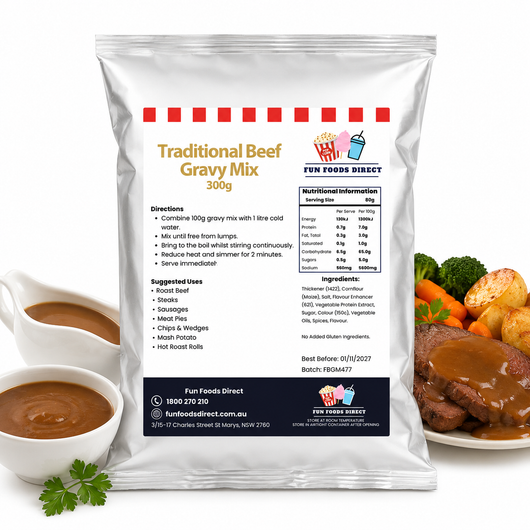
Traditional Beef Gravy 300g
A rich savoury-style choice for roast beef, steaks, sausages, hot roast rolls and mash.
Shop beef gravy →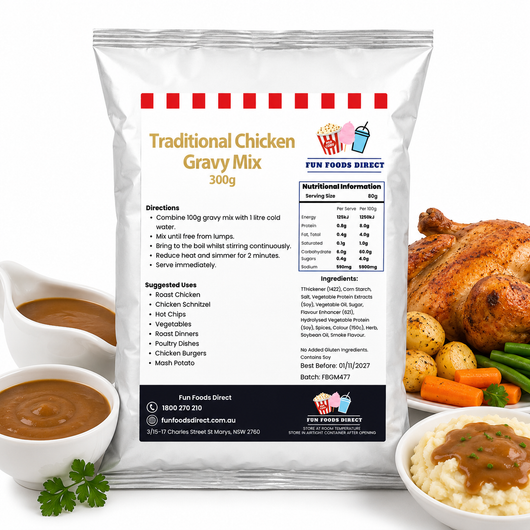
Traditional Chicken Gravy 300g
A savoury chicken-style finish for roast chicken, schnitzels, vegetables and mash.
Shop chicken gravy →Check allergens before you name a dietary option
The current Chicken Gravy ingredient listing declares soy. A description such as "no added gluten ingredients" should not be turned into an unverified gluten-free claim. Read each actual pack, review toppings and manage cross-contact. Do not assume either savoury gravy is vegetarian or suitable for every guest.
Prepare smooth gravy consistently across multiple catering batches
The store's preparation directions for both gravy mixes follow the same sequence: combine 100g powder with one litre of cold water, stir until smooth, bring to the boil while stirring continuously, reduce heat and simmer for two minutes. Use equipment that can heat the complete batch properly, then transfer for safe service.
Measure
Weigh mix and cold water using the current pack directions.
Blend
Stir thoroughly until lumps disappear before heating.
Boil
Bring to the boil while stirring, then simmer two minutes.
Verify
Check texture, usable finished volume and safe service temperature.
Don't assume a much larger saucepan needs precisely the same heating time as a small batch. Use enough heat and stirring to achieve the specified process safely. Label prepared batches, use clean utensils and avoid adjusting thickness by pouring unmeasured cold water into the service pan.

Safe gravy holding: what every catering service should check
Finished gravy may be a potentially hazardous food, depending on its preparation and ingredients. For hot holding, Food Standards Australia New Zealand advises keeping potentially hazardous food at 60°C or hotter, unless a validated alternative control is used. Check the actual food with a clean, suitable probe thermometer; the bain-marie thermostat alone is not a food-temperature reading.
reference
Heat first, then hold
Prepare or rapidly reheat gravy on appropriate heating equipment before transferring it to the bain-marie. Holding equipment is generally not designed for safely heating cold gravy from chilled. Stir using sanitised utensils, check food temperature and record checks in your food-safety system.
Cooling leftover gravy requires a separate plan
If cooked potentially hazardous gravy will be saved, FSANZ generally requires cooling from 60°C to 21°C within two hours, and from 21°C to 5°C within the next four hours, unless a proven safe alternative is in place. Use shallow containers, appropriate rapid cooling and documented checks. See FSANZ cooling and reheating guidance .
Avoid topping up a hot pan with cold gravy and assuming the holding unit will heat it quickly enough. Make fresh batches separately, keep clean batch records and replenish only when the new gravy is properly prepared and temperature-controlled.
Gravy catering FAQs
How much gravy mix is needed per litre of water?
The current Fun Foods Direct Beef Gravy and Chicken Gravy directions use 100g powder per one litre of cold water. Blend smooth, bring to the boil with stirring and simmer for two minutes. The exact usable finished volume should be measured in your kitchen.
How many guests does a 300g gravy packet serve?
It depends on your measured ladle portion and final usable yield. A full 300g packet calls for three litres of recipe water at the stated ratio, but that is not an official number of finished 80mL serves. Run a batch, measure it, then divide by your portion target.
How much gravy should I make for 100 people?
At an illustrative 80mL each, the base target is 8L of finished gravy. A discretionary 10% contingency increases this to 8.8L. Scale the powder using measured batch yield; not all guests necessarily need a gravy serving.
Can I reheat gravy directly in a bain-marie?
A bain-marie is generally holding equipment, not equipment for rapid reheating. FSANZ recommends rapidly reheating potentially hazardous food to at least 60°C before transferring it for hot holding, ideally within two hours or less.
Can prepared gravy be saved for the next day?
Only if safe cooling, refrigerated storage and reheating procedures are followed and recorded. Cool potentially hazardous food within the required time-temperature limits, and do not assume a large covered pot will chill quickly enough.
Which gravy suits roast chicken or roast beef?
Traditional Chicken Gravy is a natural match for chicken and schnitzel; Traditional Beef Gravy suits beef roasts, steaks and hot roast rolls. Check the ingredients on the actual packs before making dietary or allergen claims.
Plan the portions. Hold safely. Finish every plate well.
Explore Fun Foods Direct's genuine beef and chicken gravy mixes, test your service yield and build a repeatable plan for catering from fifty plates to two hundred.
Explore Beef & Chicken Gravy Mixes →