
How Does Fairy Floss Work? The Science Behind the Sugar
A handful of sugar becomes a cloud of fine, colourful threads. The secret isn't extra ingredients or whipped air: it's the combination of heat, a fast-spinning head and rapid cooling. Here's what actually happens—and how to use that knowledge to make better fairy floss.

 Sugar in. Fluffy threads out.
How does fairy floss work?
A fairy floss machine warms sugar until it can flow. Its rotating spinner head drives the liquid sugar through tiny openings, pulling it into long, extremely thin threads. Those threads cool and solidify almost immediately, forming the airy web we call fairy floss in Australia and cotton candy elsewhere. Nothing has been inflated: the fibres simply spread a small amount of sugar around a lot of air.
Four stages from crystal to cloud
Think of the machine as a small thermal spinning system. Each stage matters, and problems at one stage often explain what goes wrong at the serving bowl.
Start with dry sugar
Crystals are loaded into a machine-compatible spinner head. Flavoured, ready-to-use sugar already contains its colour and flavouring; it is not a liquid syrup.
Soften and melt
The heated head makes the sugar fluid enough to move through the outlets. Exact machine temperature and warm-up routine depend on the equipment—not a universal number.
Pull out fine strands
Rotation drives the liquid sugar outward through small openings. The thin streams stretch into fibres as they travel away from the spinning head.
Set into a sugar web
The threads rapidly lose heat and become solid. A clean stick gathers them into the familiar airy spiral, ready for prompt serving.
Why does it look like more sugar than you put in?
The dramatic increase is in volume, not mass. Each thin fibre occupies a very small amount of space, but thousands of fibres loosely wrapped together enclose a lot of air. That is why a generous-looking cloud can be light.
Spinning also changes the sugar's physical structure. Ordinary table sugar begins as visible crystals. Rapidly cooled spun sugar is largely an amorphous, glassy solid: its molecules have not had time to organise into the same regular crystal pattern. “Glassy” describes the molecular arrangement—not actual glass or another added ingredient.
And why does fairy floss vanish on your tongue? The strands are tiny, with a very large exposed surface area relative to their mass. Saliva can wet and dissolve them quickly. Warm, humid air causes a similar unwanted effect: moisture makes the web sticky and less stable.
More air
More volumenot more mass
The physics of melting, spinning and cooling is described by Colorado State University's Little Shop of Physics; research summarised by the University of Minnesota explains the humidity-sensitive glassy structure of spun sugar. See the source links below.
Heat changes how sugar flows
Solid crystals must become fluid enough for the head's outlets. If the machine has not reached its specified operating condition, strands may not form reliably. Avoid guessing a temperature setting for machines you have not checked.
Rotation creates the threads
The spinning head supplies outward motion and pulls liquid sugar through narrow passages. The machine is not just blowing dry granules into a cloud: the sugar undergoes heating, extrusion and cooling.
Rapid cooling preserves the airy form
Very fine streams cool quickly, setting into threads that collect around the bowl. Those fibres hold a loose structure until handling or moisture changes it.
Humidity reverses the advantage
Sugar absorbs water from the air. As the threads take up moisture, they may soften, collapse and eventually recrystallise. Keep dry sugar sealed and serve freshly made floss where practical—there is no universally guaranteed holding time.
Six ready-to-use sugars. One simple spinning principle.
Fun Foods Direct's Fairy Floss collection currently features six flavoured sugars. They are supplied coloured and flavoured for use with compatible fairy floss machines; you do not need to add a separate liquid colouring or flavour syrup. Choose flavours by the actual product listing and trial them in your machine.
Pink Strawberry Rush
A familiar pink option for party-themed servings.
View product
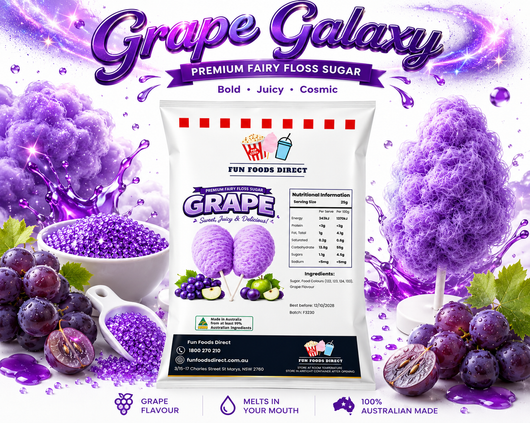
Grape Galaxy Purple
A purple choice for themed stalls and celebrations.
View product
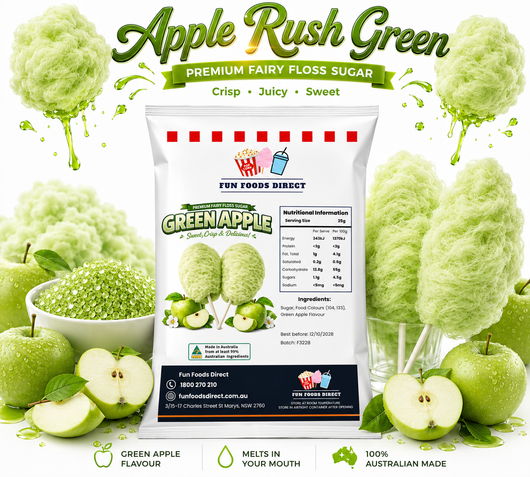
Apple Rush Green
A striking green option for playful colour pairings.
View product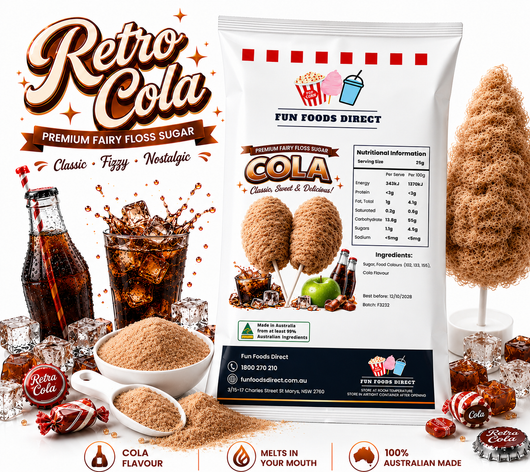
Product accuracy: Images above are the original Fun Foods Direct product visuals. Check each listing and physical label for current pack options, ingredients, colourings and allergen details. Flavour compatibility, output and colour intensity are not guaranteed across every machine.
Use the science to make a better serve
The most useful lesson is simple: keep the sugar dry, match the process to your machine, and collect fine strands without interrupting airflow or touching hot parts.
Check machine compatibility first
Confirm that your model accepts ready-to-use flavoured floss sugar. Follow the manufacturer's loading quantities, guard requirements, electrical setup and approved operating instructions. Do not assume home and commercial machines use the same settings.
Prepare a clean, dry bowl
Moisture encourages sugar clumping, while residues can obstruct openings. Inspect food-contact parts and sanitise where required. Reassemble correctly and ensure components are dry before use.
Preheat according to the manual
Fun Foods Direct's general guide suggests approximately 3–5 minutes for suitable machines, but the manufacturer's instructions take priority. The goal is a stable working condition, not an assumed universal heat level.
Load the instructed amount
Measure the recommended quantity of dry floss sugar. Avoid overfilling and never pour water or syrup into a spinner head designed for dry sugar. Follow the manual's instructions for loading a moving or stationary head.
Collect gently and consistently
As strands appear, wind a suitable clean stick in the approved collection area. Keep fingers, clothing and loose items away from rotating and hot components. Do not press the stick into the head.
Serve fresh; shut down safely
Serve promptly or use suitable dry, food-safe packaging if preparing ahead. At the end of service, complete the exact shutdown and cool-down steps for your machine before cleaning it.
Test three portions instead of guessing yield
A cone's apparent size is deceptive because air contributes so much volume. To estimate stock for a market, school fete or café special, measure the dry sugar used for real servings. Keep the machine and winding technique consistent while you trial a few sizes.
Three-serve test protocol
- Record the exact sugar product, machine model and weather or humidity conditions.
- Set up the equipment according to the manual and preheat correctly.
- Weigh the sugar for three trial portions before loading it, one portion at a time as permitted by the machine.
- Note the finished serving size, any rejected threads and the time taken.
- Choose an achievable serving standard; include a realistic allowance for test runs and losses.
What 1 kg means on paper
Illustrative dry-sugar portions only; these are not guaranteed machine yields.
| Dry sugar per serve | Maximum full portions from 1 kg* |
|---|---|
| 12 g | 83 |
| 16 g | 62 |
| 20 g | 50 |
*Mathematical upper bound before waste, residue, trial portions or other losses. A 16 g portion leaves 8 g unused from 1 kg after 62 complete portions. Your actual product and machine results may vary.
For a detailed event worksheet, see the 50- and 100-serve fairy floss yield guide.
When the floss doesn't behave, follow the science
These are starting checks, not instructions to adjust internal electronics or bypass safety controls. Stop the machine and follow the manufacturer's troubleshooting procedure where needed.
| What you see | Possible explanation | Safer next check |
|---|---|---|
| Few or no sugar threads | Insufficient warm-up, blocked outlets, incompatible sugar or incorrect loading may interfere with extrusion. | Check warm-up, approved sugar type and loading instructions. Inspect only after a safe shutdown and cool-down. |
| Hard blobs rather than fine strands | The sugar may not be flowing or stretching as expected, or the head may be overfilled. | Recheck loading quantity and machine setup; consult the equipment manual before changing any settings. |
| Floss turns sticky or collapses | The high-surface-area threads absorb moisture and lose their airy structure. | Keep dry sugar sealed, avoid steamy stations, reduce exposure time and use appropriate dry packaging. |
| Clumped sugar in storage | Moisture may have entered the bag or container. | Check the package condition and label directions. Do not load wet or contaminated sugar. |
| Residue between flavours | Remaining sugar or colour may carry over to the next batch. | Use the machine's approved changeover and cleaning method after proper shutdown. |
| Smoke, unusual odour or noise | A possible equipment or overheating fault. | Stop use and follow the manufacturer's safe shutdown procedure; seek qualified servicing if needed. |
Do not promise a particular performance from any sugar without testing it in the specified machine. For general support, review Fun Foods Direct's preparation and troubleshooting guidance.
A simple three-zone setup makes science useful at service
For a school fete, party hire setup or concession stand, separate dry sugar storage, the hot machine and the handover area. The operator can then focus on heating and spinning while the serving process stays organised.
Keep sticks clean and protected from contamination; avoid reaching across the hot equipment to access supplies. For allergens or special dietary requests, consult each current product label rather than assuming every coloured sugar has the same formulation.
Fairy floss science FAQs
Is fairy floss the same thing as cotton candy?
Yes. “Fairy floss” is the usual term in Australia; “cotton candy” is common in the United States. Both describe fine threads of spun sugar collected into a light, airy serve.
Is fairy floss made by blowing air into sugar?
No. The machine melts sugar and uses a rotating head to send it through tiny openings. Rapidly cooled threads collect loosely with air between them, which makes the portion look much larger than its weight suggests.
Why does fairy floss melt in your mouth?
Its extremely thin sugar fibres have a large exposed surface area. Saliva quickly wets and dissolves them, so the airy structure disappears almost immediately.
Why does fairy floss shrink on a humid day?
Spun sugar readily absorbs moisture from the air. The glassy threads become soft or sticky and can collapse. Serving promptly and using suitable dry food-safe packaging can help, but no universal crisp or fluffy holding time is guaranteed.
Do I add water to Fun Foods Direct flavoured fairy floss sugar?
No. The listed sugars are ready-to-use dry products with colour and flavour already added. Follow your specific fairy floss machine's dry-sugar loading instructions; do not pour syrup or water into a head that requires dry sugar.
Can I use regular white sugar in any fairy floss machine?
Not automatically. Some machines accept appropriate granulated sugar, while others specify particular sugar types or crystal sizes. Check the equipment manual first. Prepared floss sugar gives you a pre-coloured, pre-flavoured option for compatible machines.
What temperature does a fairy floss machine need?
There is no universal setting that can safely be recommended for every model. The head must heat its sugar sufficiently for spinning, but equipment design and operating controls vary. Use the manufacturer's warm-up and operating instructions.
How many serves does 1 kg of fairy floss sugar make?
It depends on your measured dry-sugar portion and actual losses. For illustration, 1,000 g divided by 16 g allows 62 complete theoretical portions before waste. This is not a product yield guarantee; test your own machine and serving size.
Can I assume all flavoured fairy floss sugars are allergen-free?
No. Review the exact current ingredient label, allergen declaration and relevant certification documents for each flavour. Product colour or flavour names do not establish dietary suitability.
Make the physics colourful.
Choose a ready-to-use Fun Foods Direct flavour, match it with a compatible machine, and test one repeatable portion. Once your heat, loading and winding routine is under control, the science turns into a simple, dependable way to prepare a beautiful treat.