
How to Layer Dessert Sauce and Crunch for the Best Texture
Good dessert layering is not about adding the most toppings. It is about keeping smooth sauce, cold cream and crisp pieces distinct long enough for customers to enjoy each one. This practical guide shows where each ingredient belongs, when to add it and how to test the result in your own café or dessert bar.
answer.
Build cold or soft bases first, place sauce in a thin controlled layer, and save most dry crunch for the final garnish. For a dessert eaten immediately, you can tuck a little crumb between creamy layers. For takeaway or delivery, keep more crunch on top or pack it separately. The best sequence depends on moisture, temperature, serving time and the topping itself.
Why does crunch go soft under dessert sauce?
Dry biscuit crumbs, wafer pieces and honeycomb feel crisp because their structure breaks readily when bitten. But when they sit against a wet ingredient, moisture can move into their surface and change that structure. Sauce can also coat pieces so their edges no longer give the same snap. In frozen desserts, melting ice cream provides another source of moisture.
The question is not whether every sauce makes every crunch soggy instantly. Different coatings, particle sizes, temperatures and serving times all matter. A thick fudge may behave differently from a flowing strawberry topping. Large honeycomb pieces do not behave exactly like fine biscuit dust. That is why testing your actual combinations is more reliable than relying on one universal "crunch lasts X minutes" rule.
Moisture contact
A dry topping exposed to sauce or melting ice cream can absorb moisture. Use a smaller sauce ribbon and keep a separate dry finish for the cleanest bite.
Piece size
Very fine crumbs blend into a soft layer quickly; larger biscuit or waffle pieces can remain more noticeable. Choose the size that suits your cup and spoon.
Service delay
Five minutes at the pass, a takeaway journey and immediate table service are different situations. Assemble and test under your actual serving conditions.
Important product distinction: Fun Foods Direct Loaded Caramelised Biscuit Topping and Pistachio Topping are smooth flavour toppings. They can create biscuit or nut-inspired flavour, but they do not replace a dry crunch garnish. Pair them with a separately chosen dry product when you want an actual crisp layer.
Six steps to build distinct, satisfying layers
Use this as an adaptable kitchen method, not a fixed manufacturer recipe. Start with your own tested base, serving cup and suitable ready-to-use toppings.
Begin with a stable base
Place the first scoop, measured soft serve or prepared dessert filling into a clean food-safe cup. Keep the base at its appropriate serving temperature, and avoid unnecessary time on the bench. A stable base provides a surface for even layering.
Apply sauce as a controlled ribbon
Use a spoon or appropriate dispenser to add a narrow stripe down the inside wall of the cup or across the base. This delivers flavour without drenching every future crunchy ingredient. For a thick fudge, follow the product's cold-use or gentle-warming directions rather than overheating it.
Create a creamy buffer
Add the next layer of soft serve, ice cream, yoghurt or compatible filling. A creamy buffer helps keep the finishing crunch from sitting directly in a pool of syrup. Smooth the surface with a clean utensil if you need a flat ledge for later toppings.
Add a small inner crunch only for quick service
If the dessert will be eaten soon, try a restrained band of biscuit crumb or waffle crunch near the outer edge. Leave some pieces exposed rather than soaking them. If the cup may wait, skip this internal layer and hold the crunch separately.
Finish with a visible sauce accent
Add a final short drizzle or ripple, keeping space for dry garnish. A contrasting colour such as strawberry on vanilla or chocolate fudge on light ice cream helps customers see the ingredients. More sauce is not automatically better.
Scatter dry crunch, then serve
Use a measured spoon to place dry pieces on exposed cream or the edge of the dessert. This is the final action before handing over the serve. For takeaway, run a real packaging test so lids, travel movement and condensation do not spoil your chosen arrangement.
Choose a sauce that suits the layer
These are genuine Fun Foods Direct products from the Milkshake & Dessert Toppings collection. Their original store images and product pages are linked directly below.

Chocolate Fudge Sundae Topping
1.2 kg commercial sauce
Thick cocoa fudge for a clear drizzle or a controlled middle ribbon.
View product
Salted Caramel Fudge Sundae Topping
1.2 kg commercial sauce
Smooth salty-sweet fudge: use a little through the base and finish with a thin line.
View product
Strawberry Fruit Sundae Fudge
2 L ready-to-use fruit topping
A flowing, bright fruit-style sauce for a neat stripe against light-coloured bases.
View product
Pistachio Premium Dessert Topping
300 ml / 2 L listed variants
Smooth pistachio-flavoured topping for flavour contrast and a restrained final drizzle.
View product
Loaded Caramelised Biscuit Topping
300 ml ready-to-use sauce
A biscuit-inspired flavour in a smooth topping; add real dry crumbs for a separate crunch.
View product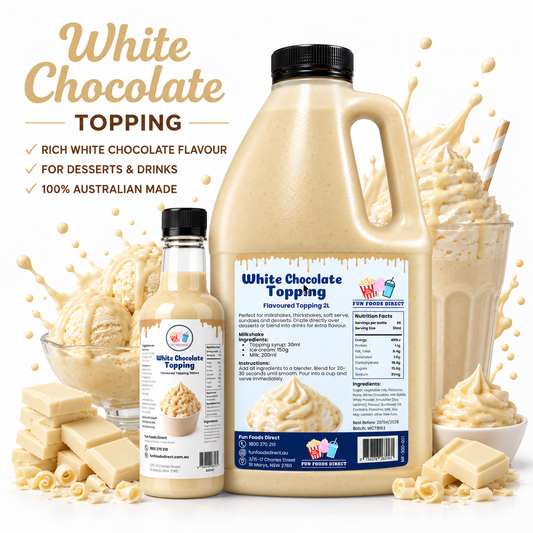
White Chocolate Premium Dessert Topping
300 ml / 2 L listed variants
Creamy white-chocolate flavour that suits a light finish over biscuit or nut crunch.
View productChoosing between formats: the 1.2 kg fudge pouches offer a thick, controlled drizzle, while other premium topping bottles offer their own flow characteristics. Check the exact package directions. The commercial fudge toppings listed here specifically require refrigeration after opening and use within four weeks; that is not a blanket storage rule for every bottle in the collection.
Now select a genuinely dry crunch
Because the supplied Milkshake Toppings collection centres on sauces, these four authentic, complementary Fun Foods Direct products come from the separate Soft Serve Mix-Ins collection. They supply the crunch component that a smooth flavoured topping cannot.

Waffle Crunch Salted Caramel
100 g dry crunch
Crispy waffle-style bits; keep airtight and add close to serving.
View product
Waffle Crunch Double Chocolate
100 g dry crunch
Dark, chocolate-style crunch that suits chocolate fudge and vanilla soft serve.
View product
Biscuit Crumbs
100 g dry crumb
Fine, golden biscuit texture for cheesecake-style layering and final sprinkles.
View product
Honeycomb Chunks
100 g dry crunchy pieces
Light, brittle pieces that are best added at the last moment.
View productStorage check: keep dry products securely sealed away from humidity and use clean, dry serving utensils. Do not leave an opened crunch pack exposed beside a steamy waffle station. Individual product labels determine storage and allergen rules.
Where should the sauce and crunch go?
There is no ideal layer order for every dessert. A frozen sundae, a hot waffle and a thickshake create different levels of moisture and contact. Use this decision table as a starting framework, then test what your own ingredients do.
| Format | Sauce placement | Crunch placement | Practical check |
|---|---|---|---|
| Soft serve or scoop sundae | Thin inner stripe plus light final drizzle | Top and upper edge; optional small internal band for immediate service | Does it stay noticeable to the last few spoonfuls? |
| Warm waffle or pancake | On the waffle or plate, away from your dry garnish zone | Last-minute scatter over soft serve, or a separate dry corner | Does steam soften the crunch before it reaches the table? |
| Layered takeaway cup | Controlled wall stripe between creamy sections | Pack separately when practical; add at handover | Does the lid or condensation wet the topping? |
| Milkshake or thickshake | Blend flavour topping into the drink if the recipe allows | Use as a final garnish rather than blending in when crispness is the goal | Will the pieces fit the opening and be comfortable to drink or spoon? |
On small screens, scroll the table sideways to view all four columns →
Pairings that demonstrate the method
These are flavour-and-texture starting points, not product-specific serving recommendations. Select quantities based on your cup size and menu cost targets, then test how long each remains appealing.
Chocolate fudge + double chocolate crunch
Place Chocolate Fudge against a vanilla or chocolate base, then scatter Double Chocolate Waffle Crunch over the surface. Keep part of the crunch free of fudge so it remains distinct.
Salted caramel fudge + waffle crunch
Apply a fine line of Salted Caramel Fudge within the cup. Complete the dessert with Salted Caramel Waffle Crunch just before service. Use less sauce if the flavour feels too sweet.
Strawberry fruit + biscuit crumb
Stripe a clear cup with Strawberry Fruit Sundae Fudge, add the creamy base, and finish with Biscuit Crumbs. For takeaway, assess whether a separate crumb sachet gives a better result.
Pistachio topping + honeycomb
Use a controlled ripple of Pistachio Topping before adding Honeycomb Chunks. This tests a smooth-and-brittle contrast; verify nut allergens and cross-contact for every ingredient.
Run a 10-minute side-by-side texture check
Rather than claiming any topping remains crisp for a universal number of minutes, test your own portion size, serving temperature and handover conditions.
Prepare two equal cups
- Use the same weight of base, sauce and crunch for both cups.
- In Cup A, put the measured crunch directly under the sauce.
- In Cup B, add the same crunch last, on exposed cream.
- Taste and score the crunch immediately, then at 5 and 10 minutes using food-safe testing practices.
- Repeat under your actual takeaway conditions if customers will travel with the dessert.
Record what matters
| Check time | Cup A | Cup B |
|---|---|---|
| At handover | ___ / 5 | ___ / 5 |
| After 5 min | ___ / 5 | ___ / 5 |
| After 10 min | ___ / 5 | ___ / 5 |
Use 1 for soft and 5 for clearly crisp. Also note flavour balance, visual appearance, cup size, whether the lid was on, and whether the portion was refrigerated or prepared for immediate service. This is a sensory quality test, not a food-safety holding-time test.
Reading the results: if the topping softens too early, test a coarser piece size, a smaller wet area, a later garnish, or a separate takeaway pack. Keep the base and ingredient quantity consistent between trials so you know what changed.
Make the texture repeatable and costable
Even an attractive dessert can become difficult to train if every staff member pours and sprinkles a different amount. Set a standard base weight, sauce weight and dry topping weight, then keep the test recipe beside the service station.
For illustration only, suppose one 150 g frozen dessert uses 15 g sauce and 8 g crunch. If a sauce pack costs $24 per 1.2 kg and a crunch pack costs $6 per 100 g, then the sauce component is $0.30 and the crunch component is $0.48. These are hypothetical input prices, not current store quotations.
Measure grams for products sold by weight and millilitres only when the actual product is priced by volume. Never assume 1 g equals 1 mL for a thick topping.
Worked cost per dessert
Illustrative ingredient-and-packaging cost only. Excludes GST treatment, labour, overheads, delivery, rejected portions and waste. Replace assumptions with your own verified invoices and measured servings.
Protect texture without compromising food safety
At the topping station
- Portion sauce with a clean, suitable pump, bottle or spoon.
- Use dry utensils for crumbs and honeycomb; keep packages closed between serves.
- Prepare small batches only when the product's directions allow it.
- Label open dates and follow the specific product's after-opening storage instructions.
- Take a reference photo of the completed cup for staff training.
For busy service and takeaway
- Keep a consistent sequence: base, sauce, buffer, dry finish.
- Use separate dry garnish where travel time makes early assembly unsuitable.
- Keep ice cream and other potentially hazardous dairy ingredients under proper temperature control.
- Check allergen labels, especially milk, soy, wheat and nuts, and manage cross-contact between topping stations.
- Assess both flavour and texture after a real handover delay.
Check the product label, not a generic storage guess
For the specific Fun Foods Direct Chocolate Fudge Sundae Topping 1.2 kg and Salted Caramel Fudge 1.2 kg, the current product pages direct refrigeration after opening and use within four weeks. Other sauces and dry mix-ins have their own requirements. Follow the label you receive and the current Fun Foods Direct storage guide. For potentially hazardous dairy-based foods, follow FSANZ temperature-control requirements. A quality test at 5 or 10 minutes is never permission to hold unsafe food unrefrigerated.
Frequently asked questions
Should sauce go under or over crunchy toppings?
Both can work, but for the most noticeable final crunch, place most of the dry topping on exposed cream and use the sauce as a controlled stripe beside or beneath it. A small internal crumb layer is better suited to immediate service than a long takeaway journey.
Why do biscuit crumbs get soggy on ice cream?
They can absorb moisture from sauce and melting ice cream, while wet coatings reduce the crisp bite. Fine pieces may soften or disappear into the base sooner than coarse pieces. Test the actual crumb, sauce and portion size.
Can I layer sauce and crunch in advance?
You can assemble some components ahead only if food-safety and product instructions permit it, but texture can change during holding. For a fresh crisp finish, keep crunchy ingredients dry and add them near serving. For takeaway, a separate garnish may work better.
Is Loaded Caramelised Biscuit Topping crunchy?
No. The currently listed Fun Foods Direct Loaded Caramelised Biscuit Premium Topping is a smooth, ready-to-use flavoured sauce. Pair it with actual dry biscuit crumbs or waffle crunch for a contrasting crunchy element.
Which sauces work with waffle crunch?
Chocolate fudge and salted caramel fudge are practical flavour pairings; white chocolate and pistachio flavour toppings are other options. Select for flavour balance first, then test whether the sauce's thickness and quantity leave enough dry crunch uncovered.
Should I warm chocolate fudge before layering?
The listed Chocolate Fudge Sundae Topping can be served cold or lightly warmed for a smoother pour. Follow its instructions, warm only as directed, and do not pour excessively hot sauce over a frozen base or store warm sauce incorrectly.
What works best for delivery sundae cups?
A controlled sauce stripe inside the cup and dry crunch packed separately can help preserve texture. Check your lid, packaging, travel time and relevant food-temperature controls. Test a complete packed serve before adding it to the menu.
How much sauce and crunch should I add?
There is no universal quantity. A trial using 15 g sauce and 8 g crunch on a 150 g base is only an illustrative starting point, not a manufacturer direction. Adjust to your product, flavour strength, portion cost and service requirements.
Are crunch toppings safe for customers with allergies?
Check each current product label and your ingredient list. Biscuit products can contain wheat, creamy sauces may contain milk or soy, and nut-based toppings need suitable allergen controls. Avoid cross-contact and never assume a product is allergen-free from its name.
How do I keep toppings crunchy at a busy dessert bar?
Use small service containers, clean and dry utensils, properly sealed backup stock and a consistent garnish-last process. Keep dry mixes away from steam and condensation and review their texture in real service conditions.
Operator references: Fun Foods Direct product preparation guide · Fun Foods Direct storage guidance · Food Standards Australia New Zealand - temperature control. Menu quantities and sensory timing tests in this guide are illustrative, not product-specific directions or guaranteed results.