
Sugar-Free vs Regular Slushy Mix: What Changes in the Machine?
Both Slush It formulas can start at the same measuring jug. What changes is how the ingredients help the drink freeze, what your machine permits and how you should run a changeover. Here is the operator's side-by-side guide.
The recipe ratio can stay the same. The freeze behaviour may not.
Standard Slush It regular slushy concentrates use a sugar-based formulation. The Slush It Zero range uses a different ingredient blend to provide sweetness and manage freezing without the added sugar of a conventional syrup. For the specific 2L products on these collection pages, each is diluted with four parts cold water to one part concentrate.
That shared 1:4 mixing ratio does not make the formulas interchangeable inside every machine. A slushy maker's approved recipe specifications, sugar requirements, fill limits and operating programs may be different. Before changing mixes, read the exact product label and your equipment manual.
Two different ways to build a frozen drink.
A slushy works when the liquid develops small ice crystals while retaining enough flowing liquid to dispense. The dissolved ingredients help determine how the mixture behaves as it cools.
Sweeteners plus texture-supporting ingredients
The published ingredient list for Slush It Zero Cola includes erythritol, vegetable glycerine, sucralose, xanthan gum and guar gum. These ingredients have different functions: some contribute sweetness; others support freezing behaviour and consistency.
- The product is formulated for a sugar-free frozen drink.
- Use the specific 1:4 directions, not a recipe improvised for plain diet cordial.
- Always check if the machine supports the formula's freezing characteristics.
Sugar contributes to sweetness and freezing control
A standard sugar-based slushy syrup uses sugar not just for sweetness but also as part of the dissolved solids that affect when ice forms and how the frozen drink dispenses. That is why the syrup-to-water ratio matters.
- Correct dilution helps maintain the intended sugar and flavour balance.
- Too much water can shift the texture towards a firmer, icier result.
- Do not assume every brand of regular concentrate has the same recipe.
A Brix reading reflects how a solution responds to light; it should not be treated as a universal sugar measurement for a sweetener-and-glycerine formula. Do not apply a regular-syrup Brix target to Zero unless the supplier and machine manufacturer have validated it for that recipe.
What actually changes at the machine?
This is the practical comparison to use when switching tanks, training staff or deciding what to stock. It covers the particular Slush It product families shown here, not every product sold as a slushy syrup.
| Check | Slush It Zero | Regular Slush It |
|---|---|---|
| Sweetness and texture | Uses a sugar-free blend including sweeteners and other texture-supporting ingredients. | Conventional sugar-based formulation uses sugar as part of the freezing balance. |
| Listed dilution | 1 part concentrate + 4 parts water. | 1 part concentrate + 4 parts water. |
| 2L bottle yield | 10L prepared liquid before losses. | 10L prepared liquid before losses. |
| Machine suitability | Check your exact model's low-sugar / sugar-free recipe rules before use. | Check permitted sugar-based beverage requirements and fill limits. |
| Reading the mix | No borrowed regular-syrup Brix or temperature target. | Only use a Brix range if specified for that syrup and machine. |
| When changing tanks | Start with a clean, sanitised and correctly labelled system. | Likewise clean between formulas and record the new batch. |
| Menu wording | Promote as sugar free only when the prepared drink and additions support the claim. | Describe as a regular slushy; verify the particular label for dietary details. |
↔ Swipe the comparison table sideways on a small screen.
Not a universal freeze-time comparison: We cannot honestly promise that one mix freezes faster, tastes sweeter or produces more sellable serves. Machine model, liquid temperature, ambient conditions and the exact product formulation all affect the result.
Same measuring maths, different ingredient behaviour.
For both featured Fun Foods Direct 2L ranges, the current directions specify 1:4. These volumes describe prepared liquid before freezing, dispensing or wastage.
| Concentrate | Cold water | Prepared liquid | When useful |
|---|---|---|---|
| 100mL | 400mL | 500mL | Only if above the machine's minimum load |
| 200mL | 800mL | 1L | Small test batch for a compatible machine |
| 500mL | 2L | 2.5L | Smaller tank or trial service |
| 1L | 4L | 5L | Medium batch |
| 2L | 8L | 10L | Full bottle, if capacity permits |
↔ Swipe for all batch columns.
Read the label
Confirm the exact bottle, dilution and any advisory notes. Do not infer instructions from the flavour name.
Check the machine
Confirm approved formula, minimum volume, maximum fill and available programs before loading.
Measure separately
Use a clean jug for concentrate and a second measured volume for cold drinking water.
Stir thoroughly
For Zero, shake the bottle as directed before measuring. Combine fully in a clean food-safe vessel.
Record the run
Note formula, batch size, machine model and texture result; repeat only with an approved recipe.
Start with the Slush It Zero range.
Four sugar-free 2L concentrates are listed in the current collection. Each product has a direct link and its original Fun Foods Direct product photograph.

Slush It Zero Cola
A familiar cola option in the sugar-free range.

Slush It Zero Red Raspberry
Bright raspberry-style frozen drink flavour.

Slush It Zero Blue Lemonade
Sweet-tangy blue lemonade-style option.

Slush It Zero Pink Bubblegum
A pink bubblegum-flavoured frozen drink.
Or build a regular slushy menu.
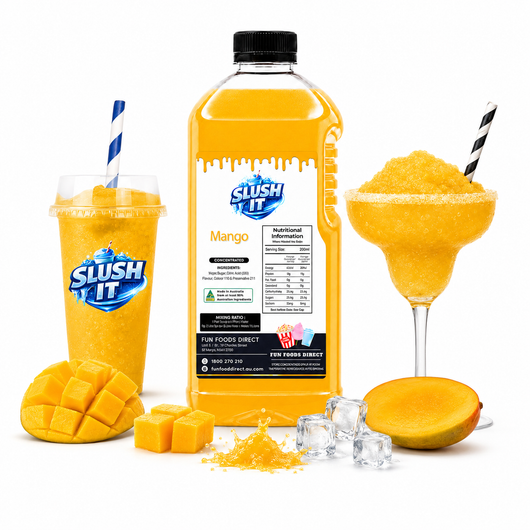
Shop regular flavours ↗These four regular Slush It concentrates use the sugar-based approach. They are not sugar-free substitutes; the full Flavoured Mixes collection has additional flavours.
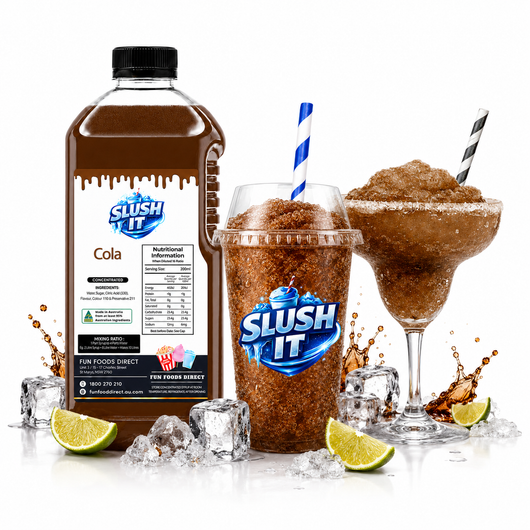
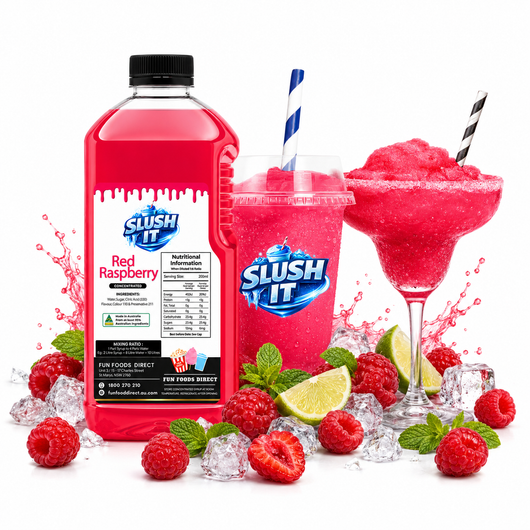
Slush It Red Raspberry
Red raspberry in the regular Slush It range.
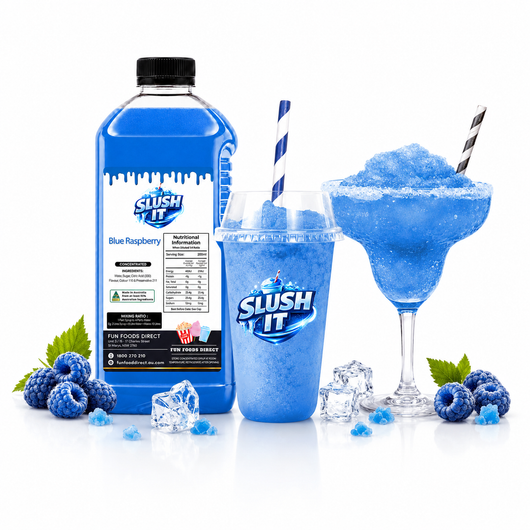
Slush It Blue Raspberry
A bright blue raspberry-style concentrate.
Can the actual machine run the actual recipe?
A product described as suitable for home or commercial slushy makers is not a promise that every machine accepts every recipe. Use a model-specific check instead of assuming that similar-looking concentrates behave identically.
Find the recipe rules
Locate the manufacturer's requirements for sugar, ingredients, temperature controls and suitable drink types. Write down your exact model, not just the brand.
Match the formulation
Compare the bottle's label and product instructions with the permitted recipes. Some machines have separate guidance for diet or low-sugar drinks.
Ask before filling
If the manual does not clearly approve the formula, contact the machine manufacturer or Fun Foods Direct with your model and syrup name before operating.
Why this matters for Ninja owners: Some Ninja SLUSHi manuals set a minimum sugar content for ordinary beverage recipes. Other guidance discusses model-dependent methods for diet and low-sugar drinks. Those instructions are not interchangeable, and the supplier's general compatibility statement cannot replace the manual for your own model. Do not put unapproved sugar-free liquid into a machine just to see whether it works.
Moving from regular to Zero? Use a clean-slate routine.
A proper changeover protects the next drink's formulation and reduces sugar carryover. Follow the complete manufacturer procedure instead of simply draining one batch and topping up with another.
Record what is in the tank and do not combine different slushy formulas.
Follow the equipment's safe emptying method; never reach into running machinery.
Wash and rinse using the machine maker's approved cleaning routine.
Use approved food-safe sanitising and any required final rinse; follow contact times.
Confirm that the new mix and chosen operating program are permitted before filling.
Measure from the new, clearly labelled bottle and use its own clean utensils.
Record recipe, tank, any alarms and texture before serving customers.
Do not describe a drink as sugar free if syrup or sugary toppings were added afterward.
Service tip: For two-tank operation, dedicate clean, labelled jugs and ingredient stations to each formula. Do not assume a quick water rinse removes enough residual regular syrup for a sugar-free menu claim.
Three texture problems, three checks to start with.
If the texture changes after a product swap, start with simple verified checks. Do not override safety systems, adjust hidden refrigeration components or invent a new syrup recipe.
Liquid stays runny
Recheck approved machine compatibility, 1:4 mixing, cold ingredient temperature, minimum/maximum fill, operating program and whether enough time has passed under the manufacturer's instructions.
Mix becomes too icy
Check for accidental extra water, the wrong preset or texture setting, and any required formulation specifications. Do not compensate by guessing syrup or sweetener additions.
Low-sugar alert appears
Stop and consult the exact machine's alert guidance. A sugar-free formulation must not be treated like ordinary diet soft drink, and no universal workaround should be assumed.
For more general diagnosis of hard or runny slushies, see the seven common freezing problems guide. Always escalate suspected mechanical failures to qualified service personnel.
Equal prepared litres do not guarantee equal service costs.
For these bottles, the listed dilution makes 10L of prepared mix either way. A 250mL nominal cup size therefore gives a mathematical maximum of 40 cups before spills, machine residue, hold-up or serving variation. It does not guarantee 40 completed drinks.
The right ingredient comparison is cost per usable serve, not only bottle price. Include the bottle cost, actual number of saleable portions, cups, cleaning, time and any discarded mix. A different machine program or an unsuccessful formulation test can change your real cost.
Recommended test: Run each product as a separate approved batch, record total sellable cups and actual discarded liquid, then compare costs using your most recent supplier invoices. Never market a presumed saving before measuring it.
Two useful product paths. One disciplined machine routine.
Offering a sugar-free slushy option?
Start by confirming that your exact machine accepts the intended Slush It Zero formulation. Then select a flavour and run the stated dilution with clean equipment.
Keeping a conventional slushy menu?
Choose a regular flavour, follow the current 1:4 directions, check your machine's sugar-based drink rules and standardise mixing across shifts.
Practical answers before your next batch.
These answers refer to the featured Slush It 2L product lines; always check the label and current instructions for the exact bottle and machine.
Do sugar-free and regular Slush It syrups use the same mixing ratio?
For the specific 2L products shown in this guide, yes: both ranges list one part concentrate to four parts water. Always check the label of the bottle you are using, particularly when switching to a different product line.
How much mix does one 2L bottle make?
A full 2L bottle plus 8L water produces 10L of prepared liquid mix. At 250mL per cup, that is a theoretical 40 serves before spills, machine hold-up and cup-filling variation.
Does a zero-sugar slushy freeze exactly like a regular slushy?
Not necessarily. Sugar-based mixes and sugar-free formulas manage freezing in different ways. Time to dispense, firmness and alerts depend on the machine model, operating conditions and exact formulation.
Can Slush It Zero be used in a Ninja SLUSHi?
The supplier markets Slush It Zero for compatible home and commercial slushy machines, but some Ninja SLUSHi manuals specify sugar limits for ordinary beverages and different guidance for low-sugar recipes. Check your exact Ninja model and current manual before filling it with the chosen Zero product; seek written confirmation if uncertain.
Should I add sugar when Slush It Zero stays liquid?
Do not automatically add sugar. It would change the intended formula and would defeat a sugar-free menu promise. Check correct 1:4 dilution, machine support, ingredient temperature, fill level and the approved program before contacting the supplier or equipment maker.
Can I use the same Brix target for both formulas?
No universal target should be assumed. A refractometer reads a solution response influenced by dissolved ingredients, not only sugar; Zero contains other dissolved ingredients. Use a range-specific reading only if the supplier and equipment manufacturer validate it for that recipe.
Can I pour regular syrup into a Zero batch to change its texture?
Do not improvise mixed-formula recipes inside the tank. Combining them changes the sweetness, sugar content and freezing behaviour and makes the resulting drink unsuitable for a sugar-free label. Prepare each recipe separately and follow approved instructions.
Do I need to wash a machine before changing from regular to sugar-free?
Yes. Follow the machine manufacturer's complete drain, clean, sanitise and rinse directions before a new formulation, rather than merely topping up. This helps prevent carryover, protects menu claims and maintains hygienic food-contact surfaces.
Is sugar-free the same as calorie-free or suitable for every diet?
No. A sugar-free statement does not by itself establish zero kilojoules, allergen absence or suitability for a particular health condition. Check each product's current nutrition panel, ingredient list and any advisory statements.
How can I choose between regular and Zero for my two-tank machine?
First confirm that your model supports each formulation. Then select one verified flavour for each tank, keep labelled batch jugs separate, document each batch recipe and train staff not to transfer or combine mixes. Review the finished drink's sugar-free status whenever extra toppings are added.